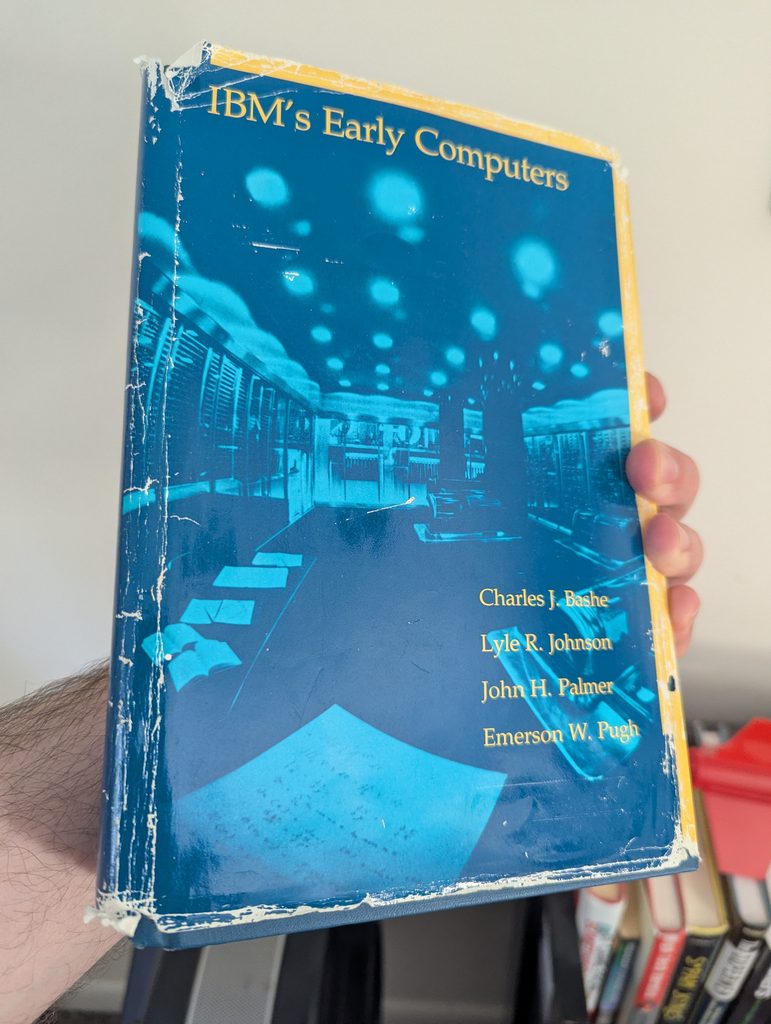
The history of personal computers is something you can find covered in all manner of media. It’s beyond a cult following and well into mythmaking. What’s often lost is that there’s a history of computing that reaches much further into the past; most histories treat anything before minicomputers (and, increasingly minicomputers themselves) as a given and tell the story of the PC. But the minicomputer era relied on prior art, and this is what we hear about in IBM.
If you ever wanted to know how hard disc drives or magnetic tape were invented or how early architecture was worked out this textbook is actually a treasure trove.
From my perspective the most interesting section is of course the chapter on Programming featuring early assembly (etymology: related to the fact that they were writing programs for the so called “Test Assembly?”) and ‘speed code’, stuff that predates the history of programming languages as such.
The EVN wiki recently moved off the awful ‘fandom’ platform. This is a thrilling development and I’m extremely grateful to the hard work of Sharky et al. Update your links to the EVN wiki, people.
This is another neat mod, interesting to see that Alpha Smarts are still used in some capacity. I would say I learned to type on those things but it would be more accurate to say that I tried to learn to type on those but didn’t ultimately succeed until I was shamed for my slow typing and spelling mistakes in Starcraft games.
ACM digital library is now open access. This is something that I really enjoyed accessing back in college. This one’s my favorite: HOPL: The first conference book and subsequent conferences.
An intriguing approach to avoiding supply chain attacks, though I wonder if it’s going to cause a free rider problem and ultimately reach an equilibrium where it just pushes back how long it takes for supply chain attacks to get noticed and fixed.
Holograms used to be everywhere. I have a vivid memory of someone swimming around with a pair of goggles with a pair of holographic sharks on them. but I’d never really considered how the effect was achieved. This helps one understand the surreal quality that holograms of this type tend to have; they’re often of a model!
Used to be in order to professionally google bomb something you had to make like Sue Sch*ff and create dozens of websites to push everything else off the front page of Google. Nowadays you just vibecode a slopsite and the google bot will spit it out as gospel. Excellent!
Another ‘state of the industry’ essay, don’t miss the followup. Spoiler for the conclusion:
if you’re like me and getting forced to gain fluency with this tech, defend yourself. Go to absurd lengths to protect and grow your skills despite the potential slopification of your day job. Read more. Code more. Write more. Complain more. At least that’s what I’m doing.
Another major foss project has set out a fairly restrictive LLM policy. Though much more diplomatic than the others, it’s clear that the community sees that its continued existence as a community relies on human contributors.
This last year has been exhausting. The PR departments of the frontier labs have done an excellent job convincing us that AI developments are occurring at an astounding, world-changing rate. But if you zoom out, it becomes clear that almost every “breakthrough” since last summer has concerned the narrow domains of computer code and math, which are defined by highly structured languages and come accompanied by massive amounts of specialized training data.