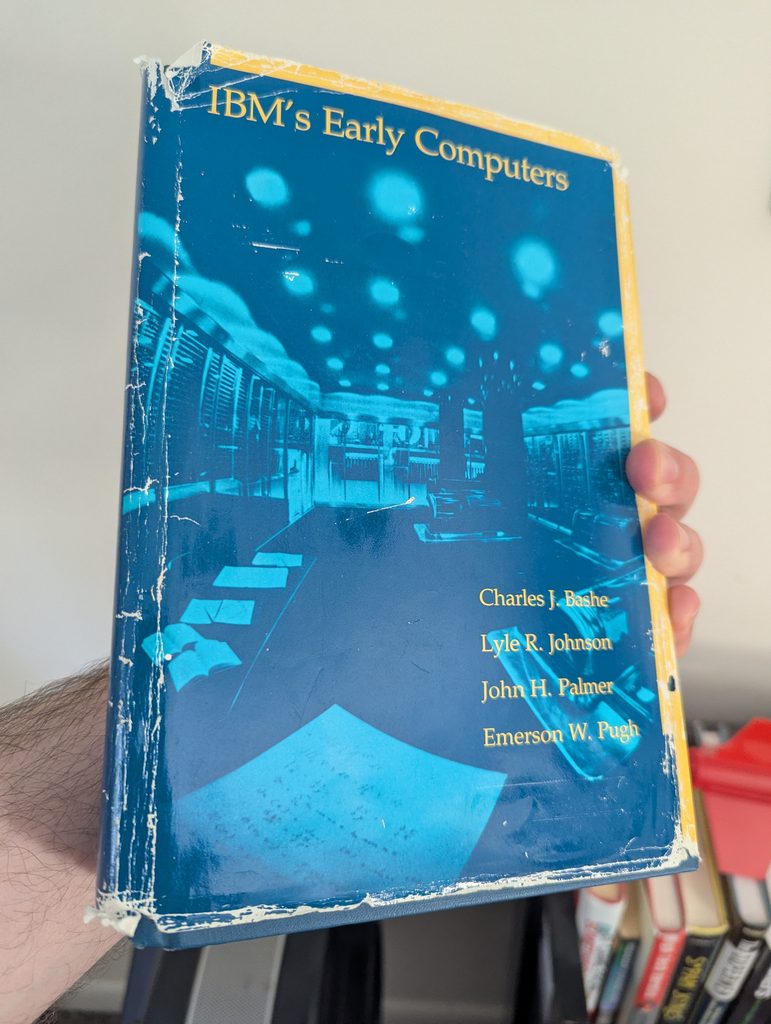
The history of personal computers is something you can find covered in all manner of media. It’s beyond a cult following and well into mythmaking. What’s often lost is that there’s a history of computing that reaches much further into the past; most histories treat anything before minicomputers (and, increasingly minicomputers themselves) as a given and tell the story of the PC. But the minicomputer era relied on prior art, and this is what we hear about in IBM.
If you ever wanted to know how hard disc drives or magnetic tape were invented or how early architecture was worked out this textbook is actually a treasure trove.
From my perspective the most interesting section is of course the chapter on Programming featuring early assembly (etymology: related to the fact that they were writing programs for the so called “Test Assembly?”) and ‘speed code’, stuff that predates the history of programming languages as such.
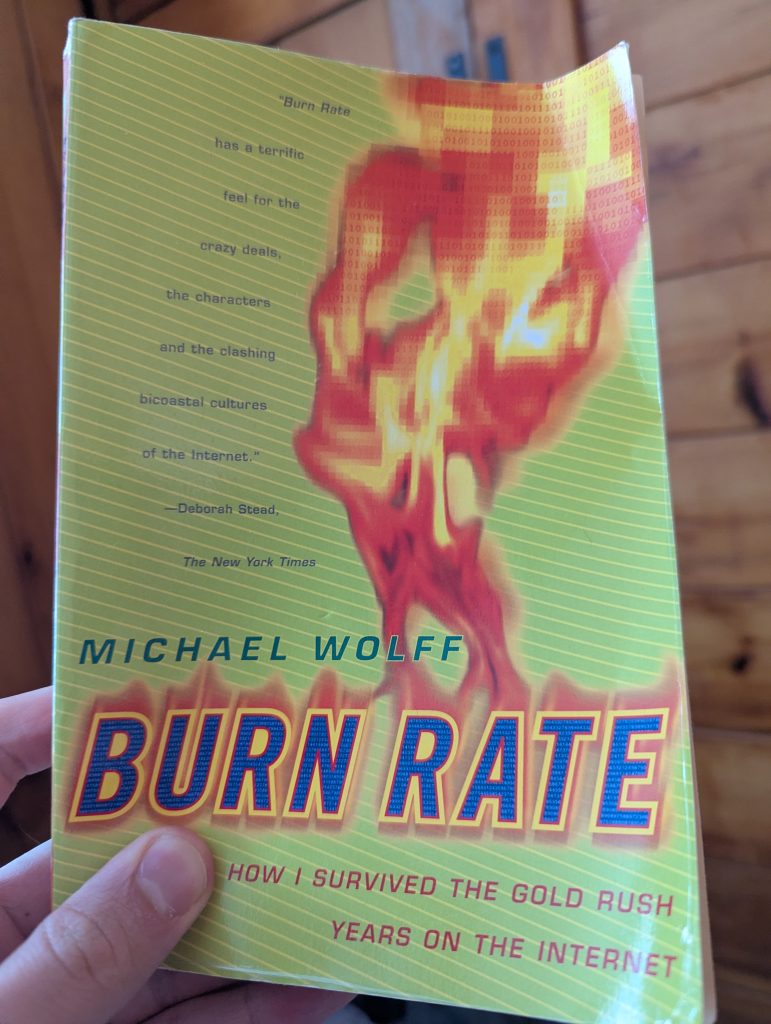
Dot Con was good but I felt it was lacking a lot of color, what it was like to experience the the bubble from the inside. Burn Rate has it in spades. This is the story of a single CEO in the midst of the dot com boom running around and trying to secure enough capital to keep his money-burning company afloat. The dialogue is worthy of a Max Barry or Ian M Banks novel. Especially his conversations with his wife/counsel.
Wolff is a bastard. He sells a grandmom-and-pop magazine company his lemon of a database, runs out of money, sells air like a conman and ultimately tries to screw his investors. He shows little or no concern for anyone but himself–not his wife, not his employees, and last of all his customers. His concern is singular: he wants a big payout.
What’s truly insane is that this book was out in 1998. This wasn’t some expose of the bubble nor did the account of numerous dotcoms being dead companies walking or outright ponzis serve to deflate it. It kept rolling for years.
Before people could ask a chatbot their programming questions, they asked living breathing humans. If you’re stuck setting up Linux or want to talk to someone about a new programming language you’re learning, chat applications still exist.
Discord is the obvious choice for a lot of projects and offers plenty of features. However owing to the low barrier to entry Discords can be rather crowded and hard to get a word in on. Instead, I recommend those with a retro sensibility to try out IRC.
IRC is not only still around but still large enough for network drama. It’s especially popular for FOSS projects. The problem is presence: you will only get IRC messages while you’re connected. This is great for always-on desktops but not great for the sort of asynchronous communication style that my Slack-addled brain needs.
So first you’ll need an always-on machine. I’m using a raspberry pi I keep around the house for coding but you could use a cloud server too.
You can connect to it with JuiceSSH Use tmux to avoid getting disconnected when you disconnect.
Use IRSSI. Connect to the server with /connect and then connect to the channel with /join (most start with ##)
Finally, to cut down the noise, use this command to hide noise messages:
/ignore -channels #channel * JOINS PARTS QUITS NICKS
Let’s talk about something absolutely frivolous today. The tiny icon displayed in your broswer for sites, which is called a “favicon.” This is the original favicon I made in 2014 when I first set up a website. I believe I just popped open GIMP, threw in a serif typeface and spelled out my initials.
This is fine, though bland. It served me well until I busted it on my webserver setup and started serving the whole site on favicon.ico (oops!) Fixing it has given me an opportunity to make something new. Still black text on a white field (until such a time as I find a new color scheme) and still my initials. But I wanted to pick a more unique typeface. Something that really spoke to me.
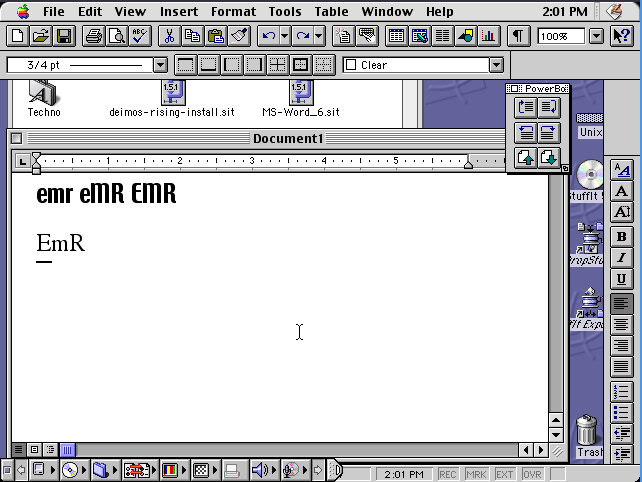
When I was first exposed to computer typography it seemed like a good idea to use zany fonts in the school papers I submitted. One I probably used the most was called Techno by David Berlow. I certainly remember the feel of a full paper written in Techno–not particularly legible (especially with my atrocious grade-school spelling) but extremely slick and modern looking. It loudly proclaimed itself as something you typed into one of these amazing ‘computer’ machines (or perhaps into the microscopic screen of an alphasmart.) All that optimism and retro cred was perfect. Techno was the font for me. So I went to see if anyone had uploaded it…
Nope! It still seemed to only exist as something you could use on Classic Mac OS, the long-gone operating system last seen on the iconic G3 iMac. I saw some fonts that appeared close (ie here) but the kerning was wrong and the name is unfortunately used to refer to a type of futuristic font instead of the specific one I was looking for so googling was getting me nowhere. And I’m not the only one who was looking for it either! Luckily, we can emulate an iMac and run OS9 to create an image.
With a little bit of cropping and tweaking on the capital E, we have a new favicon:
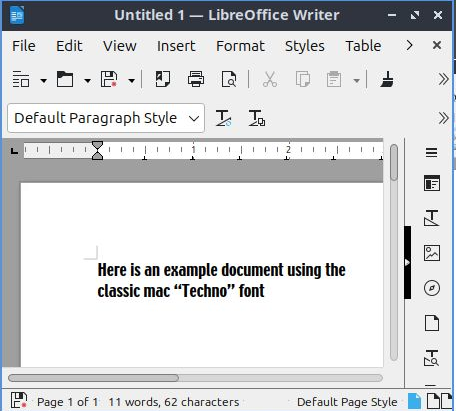
I could stop there, but needing to emulate a twenty seven year old operating system just to get a font isn’t an adventure for everyone, so why not bring these fonts into the present? Simply copying the font files out will result in resource fork problems but luckily there was a period correct app called Font Clerk which could convert them into regular true type fonts. Here are the fonts on internet archive for your enjoyment. There may be a couple of extras in there because I installed Microsoft Word to get the above screenshot.
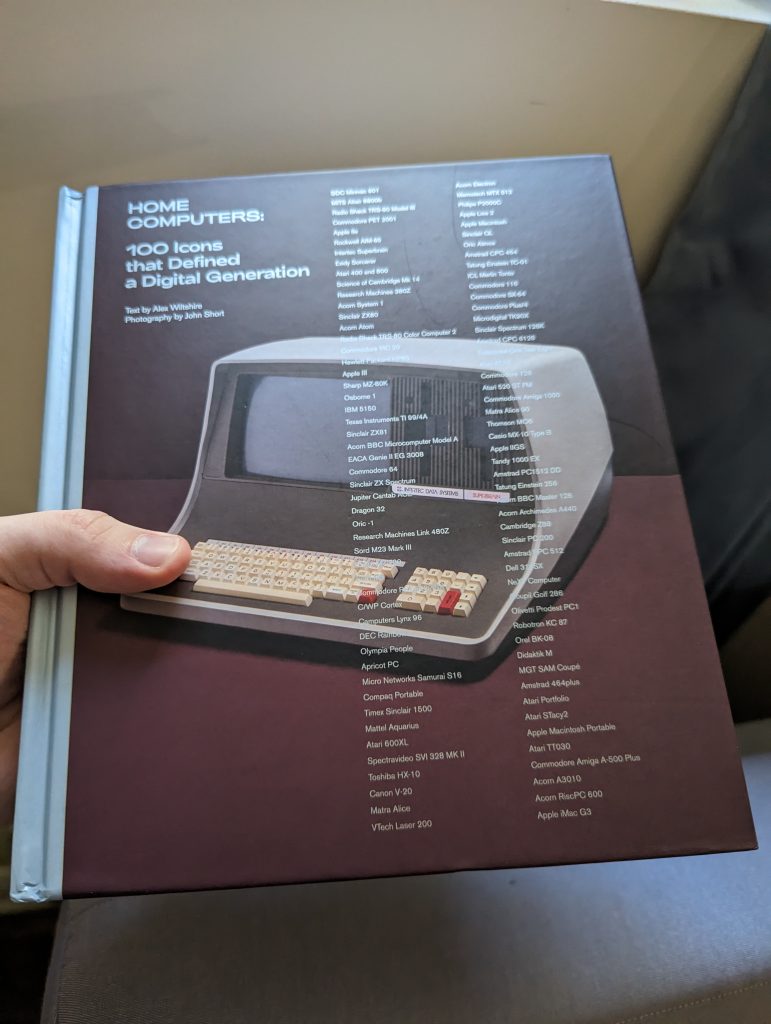
I heard about this one through respected retro computing channels, so my expectations were relatively high.
It doesn’t bill itself as such, but it’s really one of those museum collection books, in this case for the Center for Computing History. This is a fine genre, but understand that’s it is, deep down, an art book. It’s there to inspire, not as a research tool. The photographs are, therefore, artistic rather than documentary. It’s an industrial design coffee table book as much as it is a chronicle of computing.
Some reviewers have disputed the accuracy of the histories and I can’t speak to that except to say that I would have preferred the book cite its sources and spare one or two pages for a bibliography.
I appreciate that the iMac G3 is included as a sort of pinnacle of PC design though.
Might not stick with that title, but I do want to stick to the format. We’re in a period where “algorithmic” content feeds and search are becoming less than ideal, and there’s been a trend towards a smaller, more human web. I’ve long maintained a links page both as a more durable bookmark list and as a curated set of links to share. But not everything is evergreen; some things are timely, and I think a regular feature would be a more appropriate place for that. Plus it would motivate me to write a bit more, so here goes.
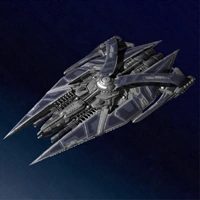
That all changed thanks to a friendly leak a year ago that didn’t really garner much attention. However thanks to the efforts of the indefatigable SharkyNebula, we now have pretty much everything on the wiki. I plan to write more about this and back up the resources on IA, but until then just marvel at these immaculate ship sprites. This was some of the best CGI that the EVN community had to offer, back in the day. They still look great now!
Tracy Kidder’s Soul of a New Machine is one of the great pieces of literature written about the computing field, and it centers on the team (lead by Tom West) upgrading the Nova into the Eclipse. Data General is a fairly obscure minicomputer company; the only one people still know by name is their more popular competitor, Digital Equipment Corporation, of PDP and VAX fame. So actually playing around with one of these wasn’t possible back in the day. But now there’s an emulator! You can even run it on a Raspberry Pi, which is exactly what I plan to do. If I get it running, I’ll write up a how-to.
For hobby modeling fans, this is a nice database of old model kits including images and enough information about them to find them via google with only a vague description. I stumbled across it while trying to figure out the provenance of a strange but very cool model kit, which turned out to be a Perry Rodan spacecraft. The model kit was purchased either at Neckers Toyland (still in operation!) or War And Pieces in Hartford (long defunct.) Seven years after War and Pieces closed, a Games Workshop store opened in the same location.
In 2007 there was apparently some drama in the YoYo community. This would make an excellent Netflix special along the lines of The Pez Outlaw. I have no idea what the veracity of the story is and it contains some fantastical elements, but it’s also exactly the kind of foot-in-mouth emergent screwup that happens when you put enough people in a room and ask them to make decisions about how they should interact with their customers. I’d love to hear the other side of the story.
If they still gave awards for “web site design” that included little site badges for the winner, this site would deserve them all. I feel like I haven’t even scratched the surface with it. Be warned – I have no idea what’s lurking under the surface here.
Ed Zitron has been on a tear lately with a lot to say about the tech industry. The basic observation that we’ve been frogboiled into a truly lackluster Google search experience is a correct one.
A short story by Theodore Sturgeon, in Thrilling Wonder Stories, June 1947. I have a very vivid memory of this story as one of the first proper scifi short stories I ever really clicked with. Reading Del Ray’s history of early scifi made me think of it again, so I figured I should save the link for next time.