The Smartest Guys in the Room (2003)

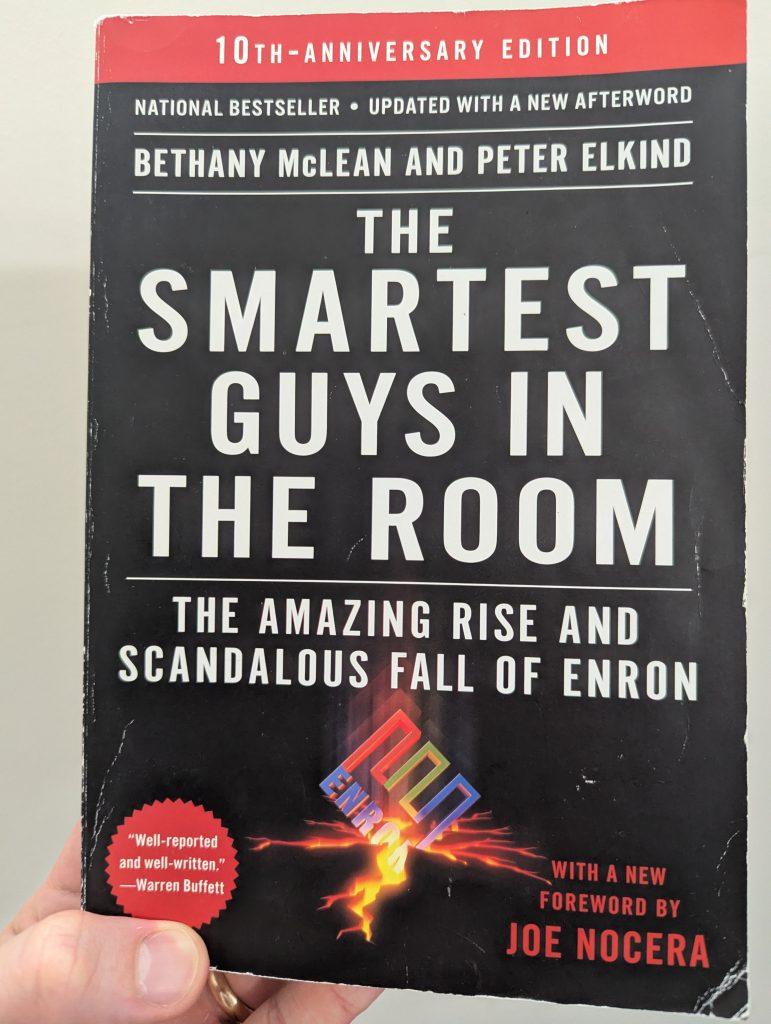
Photograph of the cover of the book

Like the story of a plane crash or bridge collapse you know what’s going to happen. Gravity is going to win in the end, and so it is with Enron. A company that tried to defy the laws of thermodynamics and conjure money from thin air with a sort of accounting perpetual motion machine. It’s an old story, over twenty five years now, but the details of the collapse still hold fascination. And there’s a bit more catharsis involved when you’re rooting for failure then when you are rooting for the pilots to land the plane against all odds in an episode of Mayday.

There’s another compelling reason to read this story in the spring of 2026 though. The inescapable drumbeat of AI calls to mind the story of Enron, so I thought it made sense to go over the history. I’m not going to write my own version of an Ed Zitron article, because he’s already done it, better than I could have. I planned on going through everything in the book and linking it to specific articles, but I don’t think that’s really needed or particularly original. So I’ll leave you with the impression of reading it: it’s well paced, well written, and contains a great amount of flavor-of-the-time, something I always look for when I chase nostalgia. They make the financial shenanigans underpinning Enron’s rampant fraud in a way comprehensible to non-accountants. They have a keen sense for when a sentence is going to land with an audible thud for the reader and structure their prose to deliver maximum impact. I have seen a lot of business literature and it rarely reaches this level of craft.

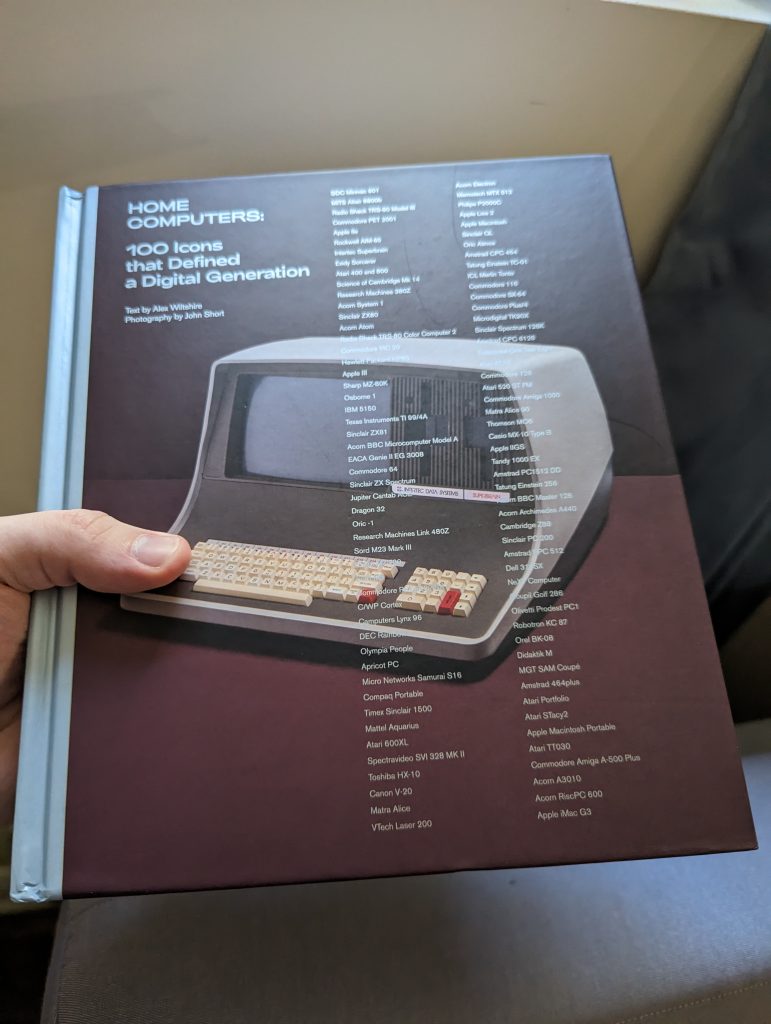
Home Computers: 100 Icons that Defined a Digital Generation (Wiltshire, Short 2020)

I heard about this one through respected retro computing channels, so my expectations were relatively high.

It doesn’t bill itself as such, but it’s really one of those museum collection books, in this case for the Center for Computing History. This is a fine genre, but understand that’s it is, deep down, an art book. It’s there to inspire, not as a research tool. The photographs are, therefore, artistic rather than documentary. It’s an industrial design coffee table book as much as it is a chronicle of computing.

Some reviewers have disputed the accuracy of the histories and I can’t speak to that except to say that I would have preferred the book cite its sources and spare one or two pages for a bibliography.

I appreciate that the iMac G3 is included as a sort of pinnacle of PC design though.

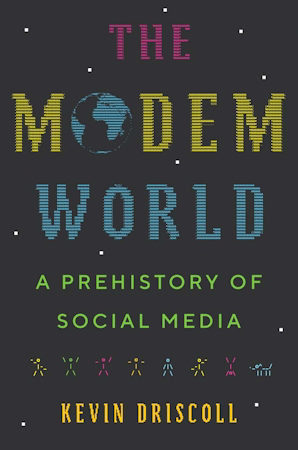
The Modem World

(image from publisher’s site)

When I was younger, I occasioned to write an essay about the history of the internet. I don’t have a copy in front of me, but I do recall that it ended up being practically a book report on the classic Where Wizards Stay Up Late by Hafner and Lyon. It gave a strong account of the technical and social factors that took us from ARPANET to TCP/IP. But apart from an excellent digression into Email, it’s sparse on the question of what factors outside of the specific technology BBN was building lead to the internet we knew in the aughts. It was a fine enough essay, I’m sure I received a passing grade for it, but I think my teacher actually had the right idea that I should have instead focused on the movie War Games.

But now, a student in a similar situation wouldn’t have to settle for inferring people’s understanding of computer networks from a movie; now they could pick up The Modem World and get a serious historical account and analysis of the proto-internet, the internet shaped thing that existed before TCP/IP became the dominant communication protocol.

While the notion of BBSs isn’t new to me (I watched the BBS Documentary, read a bunch of Textfiles.com, and frequent SDF which is BBS adjacent) The Modem World was fresh in two important ways: insight and rigor.

Most accounts of the BBS world tend to be primarily sources; people telling their own stories. You’ll find them in the pages of 2600 and the like. The Modem World goes many steps further in teasing out the statistics, explaining how affordances shaped culture, and related the history to present concerns. In this regard it’s a standout book, comfortably sitting alongside a good Platform Studies volume, or Exploding The Phone.

As far as Rigor goes, look no further than the absolutely lavish end notes for a bibliography of BBSing. Never satisfied to rest on a hand wave, the author is relentless in finding actual contemporary sources for so many assertions. I thought that it was going to rely much more heavily on the BBS Documentary than it ultimately did, because the Author dug up so much contemporary material! I appreciate the serious treatment as opposed to what frequently is the type of rose-tinted retro tech light journalism you see out of outfits that shall remain nameless.